Category Archives: Not quite a review
"Resonate: Present Visual Stories that Transform Audiences" by Nancy Duarte
Dandelion Fire by N.D. Wilson
Duel In The Sun
Evangelism and the Sovereignty of God by J. I. Packer
Empire of the Summer Moon by S.C. Gwynne
Empire of the Summer Moon
by Gwynne S.C.
Paperback: 371 pages
Publisher: Scribner
Point: The final conquering of the Indian tribes of the West was a costly and bloody endeavor for both sides. This life and death struggle culminated in the subduing of the most powerful Indian tribe in American history – the Comanches.
This gruesome tale can be summarized in two words – Quanah Parker (c. 1848-1911). The fearless Comanches and the restless settlers. The roaming and the settlers. The native and the explorers. The savage and the systematic. Both were deadly. Both were desperate for land. Both killed. Both thought they were right. Both were found in Quanah Parker.
Path: Gwynne traces the brutal history of fighting from the kidnapping of Cynthia Ann Parker, mother of Quanah Parker through the various Indian fighters of Texas such as the Rangers, Jack Hays, and R. S. Mackenzie.
Sources: The author relies heavily on sources, leaving many footnotes. However, it does not read like a textbook, but rather a systematic version of Louis L’Amour.
Agreement: One can tend to romanticize this struggle between the free roaming Indians and the settlers. Either the Indians were happy and noble yet driven to war, or the settlers were fair and kind but brutally attacked. Gwynne takes a different route. Both were bloody, systematic killers who were desperate to keep their ideals.
Disagreement: Quite graphic.
Personal App: I was challenged to see both parties as they were. It gave me a greater desire to visit the battle fields, the reservations, and the museums.
Stars: 4 out of 5
It would be worth another read and I would recommend it.
Connecting in Communities: Understanding the Dynamics of small groups
by Eddie Mosley
Print: 192 pages
Publisher: Navpress
Point: Small-groups, if properly run and well maintained, are an invaluable source of encouragement, growth, strength, and outreach.
Path: The author shares his experiences as a small-group pastor of LifePoint church and his extensive survey of the small-group movement in the past twenty years. He attempts to give reasons for small groups, practical advice in starting and maintaining small groups, and answers to the most common questions surrounding small-groups.
Sources: Mosley bases much of his study on information from Willow Creek, Saddleback, and his own experiences.
Agreement: Truthfully, it is hard to measure the benefits of Biblical small-groups. It is a shame that so many believers accept the consumer approach to church, where they come, sit, and leave without ever interacting with other believers. It is also a shame that so many churches have no vision for outreach in the communities. Mosley gives practical suggestions on how to reach out to your neighbors, be purposeful in discipling others, encourage growth in godliness, and other essential elements of the Christian walk.
Disagreement: This follows the format of much of today’s “practical guides to…” books. Scripture is cited (albeit sporadically) in order to prove a point, rather than studied to derive principles. The foundation for small-groups is weakly laid. The ideas are at times redundant and shallow.
Personal App: I was challenged to look around at how I could start a small group in my neighborhood. How many of my neighbors do I actually know? How many would come to me if there was just a death in the family? If none or few, it means I cannot possibly be loving my neighbor as Christ commanded. (And yes, I do know that Jesus meant more than simply the person next door, but he did not mean less)
Stars: 2 out of 5
Don’t read this book for your main foundation of the why or how of small-groups. Skim it for some practical advice.

Harry Potter and the Sorcerer’s Stone
Path: A small, clumsy, ignored young man, Harry Potter finds out that he is different. He is out of place and unwanted in the world of “muggles,” but in the world of magic he is known and respected by all. This young man enters the world of magic, finds friends, and faces his fears and enemies.
Agreement: The story has interesting imaginative work and you are kept in suspense the whole time. The characters were better developed than most other current works for this age group.
Disagreement: The most frustrating aspect is that Harry Potter is a clear picture of teenagers today, yet is held as an example. He feels what most most teenagers feel (alone, misunderstood, under appreciated) and acts as too many do today (sneaky, deceptive, disrespectful, disobedient). Instead of giving an example of how he can change and do right, he is basically presented as doing what was wrong in a particular instance so he could do what was right in the long run.
As for the whole magic emphasis, I am not planning on buying a broomstick, owl, or wand. You can read the positives and negatives on Andrew Peterson’s post and Dr. Bauder’s essays.
Stars: 3 out of 5
100 Cupboards
100 Cupboards by N.D. Wilson
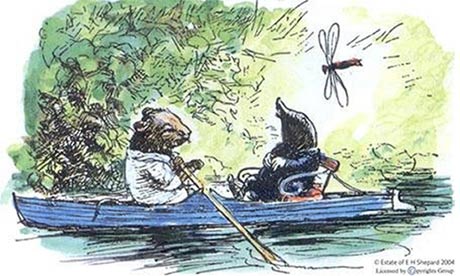
The Wind in the Willows
The Wind in the Willows by Kenneth Grahame
After another post about walking along the Themes, we started listening to this book (a librivox.org recording). It was one of my favorites!
Point: The author displays a variety of human personalities at their best and worst. He highlights true friendship and the foolishness of covetousness. He encourages a good life and not merely a busy life.
Path: The reader follows Mole, Rat, Badger and Toad through a series of adventures revealing the strengths and flaws of the individual characters. Whether it is Mole’s first encounter with Badger or Toad’s escapades in the motorcar, the stories pulls the reader along through rich vocabulary and explosive imagery.
Sources: Years of life, an imaginative mind and a cottage along the Thames converge in Grahame’s classic.
Agreement: I greatly enjoyed this fun story and found myself imagining in bold colors and vivid details as I was swept along in the current of the plot.
Disagreement: I was disappointed with Toad’s final outcome. I suppose I shouldn’t expect true repentance from a toad who steals a motorcar, but it would have been better!
Personal App: The faithfulness of Toad’s friends amazed me. I wonder if I would respond in the same way?
It would be worth another read and I would recommend it.