What?!

Here is a section from my journal:

At lunch today a friend, G, mentioned that he met a guy who was running the entire Camino alone, from France to Spain’s west coast (about 800 kilometers). Later on in the afternoon I get a text saying: “He showed up at my store! Can you come eat with us?”
G picks me up on his motorcycle and we meet up with Kevin.
He looks like he has been running for hundreds of miles. Which he has. He started eleven days ago, and has run more than a marathon and a half every day. Read that again.
G had told me he was from San Fransisco, but as we talked I asked, “You don’t sound like you are from California. Where are you from?”
Kevin: ”I am from California, but I spent some years in Minnesota.”
Me: ”Really. What part?”
Kevin: ”I went to college at St. Olaf.”
Me: ”Well, I grew up in Minnesota, and most recently lived in Edina.”
Kevin: ”My mom, and grandparents are all from Edina.”
**Strange.**
The conversation continues. We talk about running. We talk about ultras. We talk about what he is learning about himself on the Camino. Both he, and our mutual friend G, have been challenged emotionally and spiritually. As G slips away to pay the bill (something we discover later), Kevin mentions more about his religious background.
“I have grown up Lutheran but spent time in a Baptist church while in college.”
Me: ”In Minnesota? Which one?”
Kevin: ”It was in Stillwater. It was called Grace Baptist.”
Me: ”Do you know a guy named Tyler?!”
Kevin: ”We are good friends. And Shad the pastor.”
Me: ”Tyler, and his wife Olga, were in nearly every class of mine in my graduate studies!”

The funny part is that the next morning G and I were going to run with him out of Ponferrada, and we planned a time and meeting place, but never actually found him! God brought us together incredibly, and then when we tried to plan a meeting place we missed it.

I am confident there is something beyond coincidence happening here.

IMG_9557

Driving School

One of the joys of living abroad in Spain is the opportunity to brush up on my driving knowledge and skills. Here in Spain they require that those from the USA start at ground zero in their driving endeavors, which means back to the books.
In order to receive a Spanish drivers license one must first pass a theory test and then a practical test. The tests are separated by at least a week, and you have 3 opportunities to pass the two tests until you fork over another large sum of money.
My inner tightwad encouraged me to study in order not to have to pay more than necessary, so study I did.
Along with reading the driving manual as though my life depended upon it, I also took approximately 100 practice tests. A practice test is made up of 30 questions from any topic in the driving manual, of which you must get at least 27 of them correct in order to pass.
Because of the sneaky way the questions are asked on the exam, others encouraged me to take the test in English.
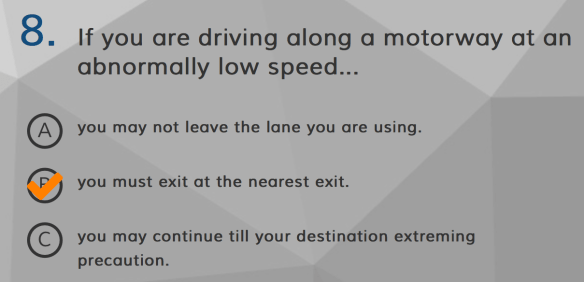
While the official test was translated well, the practice tests were “questionable.” Here are some of my favorites:

Screen Shot 2016-06-14 at 3.23.00 PM

Very important in case Thor or Loki is riding with you.

Screen Shot 2016-06-19 at 5.35.32 PM

I hate it when I brokes down!

Screen Shot 2016-06-24 at 10.21.03 PM

I get to a point when my eyes burst out fatigue, and let me tell you…

Screen Shot 2016-06-25 at 9.42.50 PM

I thought so hard about what this question could be asking I may have gotten a nosebleed.

Screen Shot 2016-06-26 at 3.33.12 PM

?

Screen Shot 2016-07-02 at 3.14.35 PM

Always, always, the rider of a motorcycle must riding wit free exhaust pipe. How many times do I have to tell you!

Screen Shot 2016-07-03 at 5.13.22 PM

If my car is ticking over too loud, I get upset.

Screen Shot 2016-07-03 at 5.24.58 PM

The right answer should always include extreming precaution.

Los Templarios

This past weekend Ponferrada celebrated several special days remembering the Templarios, or Knights Templar. The castle overlooking the city was a fortress maned by them, and in many ways, built by them. The city hosted a medieval market, a Templario feast in the castle, fireworks, and knight encampments.

IMG_9556

IMG_9582IMG_9585IMG_9589IMG_9591IMG_9597IMG_9600IMG_9602IMG_9603IMG_9606

Eat. Eat. Eat. Eat. Eat.

One thing I am extremely thankful for in the Spanish culture is the options I have for meal times.
When I wake up I have Desayuno. This could be fruit, cereal, yogurt, potatoes, pastries, etc., served with coffee (as could any of the following).
A morning snack is called Almuerzo. Normally eaten from 11-1, this could be a tapa, fruit, pastries, etc.
When we eat together in the afternoon we have Comida. This is normally the largest meal and is eaten in the middle of the day – not to be confused with noon. Midday is 2-4 pm, otherwise known around the world as the hours of siesta.
The afternoon snack is Merienda. The fruit, vegetables, or a small sandwich helps one carry over until the final meal of the day.
The evening meal is Cena. Traditionally served after 8 pm (closer to 9 or 10), our family normally eats around 7 pm on “normal” days.

Effectively, there is no time during the day when there is not a legitimate time to eat. What a beautiful thing.

IMG_8205

Semana Santa

This past week was Semana Santa, or Holy Week. It was our first time to experience a Spanish festival of this magnitude. There are many events and experiences that go into these unique days, and we were only able to mentally process a few of them.

Observations:
Around this special week one will find IMG_8430signs in nearly every dining establishment advertising “Limonada,” or “Lemonade.” This is a beverage consisting of various ingredients including some form of alcohol, fruit beverage, and a variety of flavors. It has a long history which goes back to the persecution and expulsion of the Jews under Ferdinand and Isabella (15th and 16th centuries).

There are multiple processions throughout the city at varied hours. Some starting at 6 am, and others going late into the night. They normally include trumpets, drums, religious garb (the pointed hats hold a very different meaning here than they would in the United States), and prayers. These lengthy processions have special meaning for the community in which they are enacted, the day on which they take place, and the float which they are displaying.

IMG_8495 Those who participate in the processions are normally part of a specific brotherhood, some which originated in the Middle Ages, others during the Counterreformation, and some in modern times. To outsiders like ourselves, it appears that this is often a family affair.
There are multiple celebrations of the Mass in the cathedrals around town, restricted hours of service in stores and restaurants, and an increase in visitors (at least in our city!).

IMG_8514

Thoughts:
This is both a cultural and religious time. It would be completely naive to think that this is religious for all the participants and observers.

What I appreciate:
This is a very solemn time, at least during the processions, fitting of the final days of Jesus.
I can appreciate the great lengths to which these participants have gone to commemorate the life, work, and death of Jesus.
This is a time where families unite and spend extended time together, made possible by a seemingly nationwide vacation.
This is a cultural bonding time in the life of the city and surrounding pueblos, something which is often missing in other parts of the world. It may be equivalent to a small town 4th of July parade.

IMG_8571

Where I disagree:
Because of the cultural aspect, the religious aspect can be pushed aside.
I cannot discern the heart motives, but appearance point toward a pursuit of righteousness by works, something to which Jesus was adamantly opposed (Matthew 23).
There is a great emphasis upon the days leading up to the crucifixion, but the Resurrection is all but forgotten. In contrast, Jesus, the apostles, and the early church proclaimed the life, death, burial, AND resurrection of Jesus. This final act is what stood as the seal to the completed work of Christ, and therefore takes special priority in the life of the followers of King Jesus (1 Corinthians 15).

IMG_8554

Summary:
To live in Spain is to participate in Semana Santa. It is our desire that those here might experience it not only in deed, but also in transformational belief.

IMG_8516To see more photos, you can check our our Spain Photostream here

Botillo

Botillo
When you move to a new place and want to try out their specialized cuisine, you can’t be picky.

Here in our valley, El Bierzo, a famous meal is Botillo. It is meat-stuffed pork intestines. “What meat is stuffed in there?” you may ask. That, my friend, is a good question. But as a connoisseur of hotdogs, I don’t worry about it too much.
I do know that something this good isn’t just whipped up in an afternoon. The process to make botillo is at least five days.
We are so proud of it here that one nearby village has a large statute in commemoration.

IMG_8139