Here are some photos from our week with the Firstlook group. We were able to show them around El Bierzo, see how we are working in our community, give them insight into cross cultural ministry, and see them connect with our friends here.


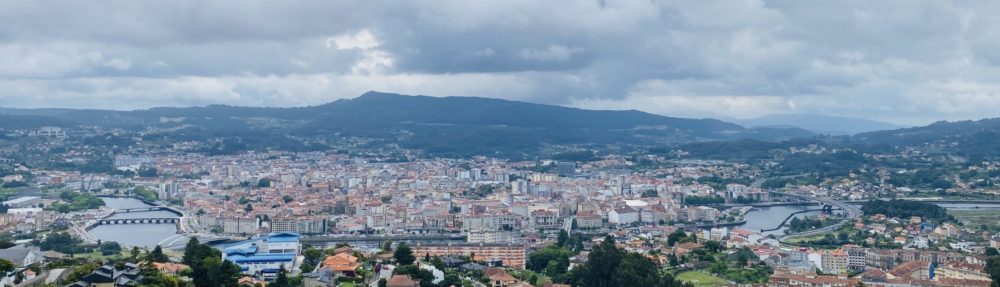
Here are some photos from our week with the Firstlook group. We were able to show them around El Bierzo, see how we are working in our community, give them insight into cross cultural ministry, and see them connect with our friends here.
Here are some photos from our trip to a castle with the Firstlook group:


April 29, 2017 I ran the 101 Peregrinos Ultramarathon in El Bierzo. Here is a review of the race.
I am a runner because I love exploring, and running enables me to see more. I am an ultra runner because I have a poor sense of direction while out exploring.
The 101 Peregrinos was my first ultra in Europe. I am a Minnesotan, meaning, I am conversant with running on cold, snowy, flat terrain. The 101 Peregrinos offered none of that, but I decided to sign up anyway. It couldn’t be all bad…
Technical aspects include a course length of 101 km (“más o menos”),  a terrain profile that looks like an echogram of a stable heart rate and then an injection of adrenaline, and an elevation gain of 3,721 meters (had I been more conversant in the metric system I may have realized that 3,721 meters is quite a bit different than 3,721 feet). I have no idea why the race initially started years ago. I do know that it involves Templar castles, Roman mines, small Spanish villages, skipping the siesta
 (unless you are a lot faster than me), and pulpo. More about pulpo later. The race is a combination of mountain bikers, 101 km ultra, 48 km marathon, and 101 km team runners. Those biking the route leave in shifts before the runners, and only the fastest runners and the slowest bikers ever see each other. A 9 am race start was a first for me as well. I suppose this counts as “Spanish timing,”and I admit, I enjoyed waking up late!

In the first kilometers we passed a 12th century Templar castle, crossed a Roman Bridge, and checked off a section of the Camino de Santiago winter route. From kilometer 4 to approximately 47 the race winds through the Spanish countryside, over hill and dale…mostly hills and not many dales. Vineyards and forests, little villages and remains of Roman gold mines break up the routine of climbing hills.
Somewhere in this  segment I managed to add a few extra kilometers (see first two sentences). I have no idea how, but it became glaringly apparent when I skipped an aid station to hit the next one in 3 kilometers. I had run out of water but figured I could fill up my hydration vest at the next one. Three kilometers came and went with no aid station. Then six kilometers passed. The Spanish sun began to do it’s work of drying out every fiber of my being, at least that is what I felt like. I tried to compensate for my thirst by eating whatever I had in my running vest. One. Great. Idea.

When I finally did get to the aid station I downed two glasses of Aquarius, a ham and cheese sandwich, and an orange. From this moment on there was something wrong with my stomach. I managed to hit the mid point of the race, Puente de Domingo Florez, maintaining my desired speed to finish in 12 hours, taking into account the horror that was about to come, “horror” meaning the 30 kilometers of consistent elevation gain.

Twenty minutes into the upward climb the clouds rolled in, the temperature dropped, and my visions of a quick dip in a mountain stream turned to how to cover my shivering arms. I had left my windbreaker at the bag drop in Puente. Another awesome idea.
The 30 kilometer climb and final 20 kilometers can be summarized fairly quickly. Diarrhea. Lying on the side of the trail trying to convince the passing runners that everything was fine, I normally look like this, and not to call the Red Cross. Trying to get fluids down. More diarrhea. Cows running down the trail. Aid stations with wild boar stew, Pulpo (fried octopus), and other great food for someone who can’t keep anything down. The long walk to the finish line was alleviated by a friend improvising as my search and rescue team, my wife and daughter stoically shivering in the wind beneath the stone walls of an ancient castle, and the accompaniment of a friend for 20 kilometers into the early morning hours. His designation of “friend” is up for review since

he would not let me quit in the last two kilometers…what kind of a friend would do that!?
With all that, of course I am going to run it again next year. I think the 101 Peregrinos offers a great experience not just in ultra running, but in history, culture, beauty, and of course, pulpo.

While looking at a map of El Bierzo we came across a monastery which we had not visited yet and was fairly close. We decided to make an adventure of it with Nikki, an intern from the US. Things got a little suspicious as the GPS guided us off of the paved road and on to a rutted gravel road. For about a kilometer we worked our way up the washed out path and then came around a bend to see a beautiful stone settlement tucked away in the valley. A man was out working in the field and upon our interrogation he explained that the monastery, or what was left of it, was private, but we could walk around and look at it – under the agreement that we not tell anyone where it is! So…consider yourself not told.
Not only did Domingo allow us to walk around, but he gave us a tour, explained the history as he heard it when his father purchased the property when Domingo was a little boy. He showed us the ways in which his farm is adapting to the monastery walls, and even gave Tanzen an antique cowbell that had been sitting in his work shed since he was a boy.
We finished the tour with a picnic in the upper meadow overlooking the El Bierzo valley. It was a great day of religious, historical, and cultural learning which I doubt we will ever forget.


In his book, Making Sense of God, Timothy Keller has two excellent chapters on identity. He makes the point that when our identity is received from God we are relieved from finding it in others, in our work, or in our own shifting views. He says:
Your work is still part of your identity, as are your family, your nationality, and so on. But they are all relieved of the terrible burden of being the ultimate source of your self and value. They no longer can distort your life as they do when they are forced into that role. They are, as it were, demoted to being just good things. Work is no longer something you use desperately to feel good about yourself. It becomes just another good gift from God that you can use to serve others.
Tanzen: I have a great idea.
Me: What is that?
Tanzen: We could go to the United States and bring back Lucky Charms!
Me: You think we should fly back to the United States just so we could buy Lucky Charms?
Tanzen: Yah!
Once a month we have a movie night with our Conversational English group. This month it was hosted at our place and we had caramel apples. Tough to keep everyone under control.


This Friday for family day we drove to Busmayor, a small village in a long valley near Galicia. It was a beautiful valley and very lush. We took a hike to see some small cascades and enjoy a picnic. We were not planning for it to be quite has cold as it was!


On Friday we went on a hike from the village Castropodame up into some Roman gold mines. One of the interesting things we came across was glowing moss in a cave!


I thought I would share some photos of the family.


